
ArrivesBy Blog
When Delivery Dates Go Wrong: How Missed Promises Drive WISMO and Hurt Shopify Stores
Inaccurate delivery dates don’t just cause support tickets. They quietly erode trust, increase churn, and hurt repeat purchases. Here’s what merchants often underestimate.
Intro
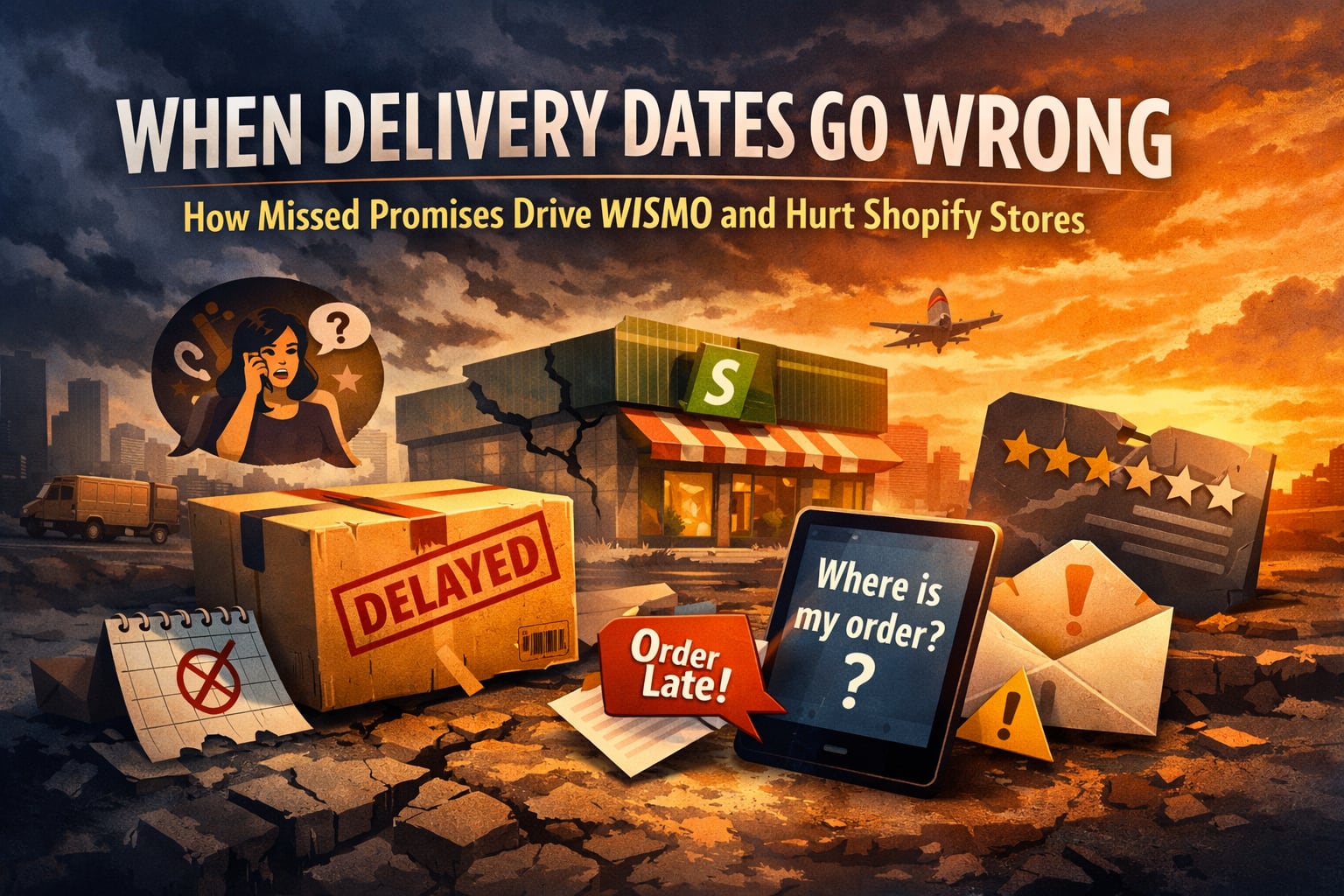
When delivery dates go wrong, the impact shows up in two places.
The first is obvious: support tickets. Customers start asking “Where is my order?” (WISMO). Emails pile up. Follow-ups increase. WISMO becomes a constant background noise in your inbox.
The second impact is quieter, but just as costly: trust.
When a shopper sees one delivery promise before buying and experiences something different after checkout, it creates doubt. Even if the order eventually arrives, the confidence they had in your store is weakened. For first-time buyers especially, that gap between expectation and reality can be enough to stop them from coming back.
These two problems often show up together, but they aren’t the same thing.
WISMO is an operational issue. Trust is a brand issue.
And both are often caused by the same root problem: delivery dates that aren’t accurate, consistent, or grounded in what actually happens after an order is placed.
In this post, we’ll look at how missed delivery expectations lead to both increased WISMO and reduced trust, why this tends to happen as stores grow, and what merchants can do to avoid letting delivery promises quietly undermine the customer experience.
The obvious cost: WISMO and support load
When delivery dates are unclear or missed, support tickets follow.
“Where is my order?” “Has this shipped yet?” “You said it would arrive by Friday.”
Each message takes time to read, investigate, and respond to. Each response adds operational cost. As order volume grows, WISMO almost always grows faster than merchants expect.
When I was running my own store, I handled support myself. That meant replying to frustrated emails and answering phone calls directly. One moment that still stands out was a customer calling me at 1 a.m., yelling that I was a scammer because his order arrived three days late.
If you’ve dealt with this, you know it’s not just extra work. It’s emotionally draining.
Many stores accept this as part of doing business. It doesn’t have to be.
Clear, accurate delivery dates are one of the most effective ways to reduce preventable support load before it ever reaches your inbox.
The less obvious cost: trust erosion
The bigger problem isn’t always the support ticket.
It’s what happens in the customer’s mind.
When delivery promises slip, shoppers start to question things silently:
- Can I trust this store?
- Will future orders arrive when they say they will?
- Do I want to buy from them again?
This erosion doesn’t always show up as a complaint. More often, it shows up as silence. Fewer repeat purchases. Lower lifetime value.
Trust is slow to build and easy to lose.
Why customers remember delivery promises more than you think
Merchants often assume shoppers won’t notice small shifts in delivery timing.
In practice, delivery dates are treated as commitments.
Customers plan around them:
- Gifts
- Travel
- Events
- Deadlines
When a delivery date is missed, it’s rarely perceived as a minor delay. It feels like a broken promise.
That gap between what was expected and what actually happened is what turns small misses into outsized reactions.
Inconsistency makes things worse
Missed delivery dates are bad.
Inconsistent delivery messaging is worse.
When shoppers see one delivery date on the product page, a different message at checkout, or nothing at all after purchase, they don’t know what to believe. This is why showing consistent delivery dates across the full buying journey — product, cart, checkout, and post-purchase — matters so much.
Some quietly leave and abandon the purchase. Others reach out to ask for clarification. Even when those conversations lead to a sale, handling them still takes time and effort.
Even if an order arrives on time, inconsistent messaging creates doubt. And doubt is what drives follow-up emails, second-guessing, and lost trust.
Why this gets harder as stores grow
Early on, missed delivery dates are rare and easy to handle.
As stores scale, complexity creeps in:
- More products and variants
- Different fulfillment paths
- International shipping
- Inventory fluctuations
- Seasonal delays
Without a system in place, delivery accuracy tends to erode over time. Tracking delivery date performance is one of the most effective ways to catch these problems before they compound.
This is exactly what happened in my store. I didn’t notice it at first. Orders were increasing, which should have felt like progress. But support tickets started piling up, and before long I dreaded checking my messages in the morning.
I stopped seeing new orders as growth. I saw them as more problems to manage.
Conclusion
Delivery dates are promises, whether merchants intend them to be or not.
When those promises are clear and accurate, they do more than improve conversions. They protect customer trust, encourage repeat purchases, reduce support strain, and preserve brand credibility. Delivery timing stops being a source of risk and becomes a stable part of the customer experience.
When delivery promises are missed or inconsistent, the cost isn’t just a support ticket. It shows up as hesitation, lost confidence, fewer repeat orders, and long-term damage to trust.
Stores that treat delivery accuracy as a core part of how their store operates are better positioned to scale without quietly losing customer confidence as order volume grows.
For merchants who want delivery promises to stay accurate and consistent as their store scales, ArrivesBy is built to support that automatically.