ArrivesBy Blog
How Pre-Order & Backorder Delivery Dates Capture More Sales
Out-of-stock doesn’t have to mean lost revenue. Here’s how accurate pre-order and backorder delivery dates turn inventory gaps into conversion opportunities.
Intro
Products going out of stock is often a “good problem” that comes with selling something customers genuinely want.
But when inventory unexpectedly runs out, it can also be stressful. Every day without stock feels like lost revenue — and lost customers — that may not come back.
In a perfect world, every product would always be available. In reality, inventory gaps happen. The difference between losing a customer and strengthening loyalty often comes down to how you handle that moment.
The right delivery messaging is a critical part of that strategy.
As we’ve discussed in Why Accurate Delivery Dates Increase Conversion, delivery timing isn’t just about speed — it’s about confidence.
Shoppers don’t always need something immediately.
What they need is clarity.
When delivery timing is clearly communicated — even if it’s weeks away — customers can make a confident decision. When it isn’t, they leave.
In this post, we explore how accurate pre-order and backorder delivery dates capture revenue that would otherwise be lost, and why setting realistic expectations matters more than immediacy.
The hidden cost of “Out of Stock”
Most stores I’ve worked with handle inventory gaps in one of three ways:
- Hiding the product completely
- Disabling the “Add to Cart” button
- Showing a vague restock message
Each of these approaches usually comes from good intentions. You don’t want to sell something you can’t fulfill. You want to protect the customer experience.
But each option has trade-offs.
Let’s break down where they fall short.
Hiding the product
This is the most damaging option.
Removing a product entirely creates SEO issues, breaks saved links and bookmarks, and frustrates returning visitors. Even if a product is permanently discontinued, keeping the page live allows customers to understand what happened and discover alternatives.
Completely hiding products also creates operational complexity. As your catalog grows, manually removing and restoring pages becomes difficult to manage.
Out of sight doesn’t mean out of demand. It usually just pushes that demand somewhere else.
Disabling the “Add to Cart” button
This is Shopify’s default behavior and is a major improvement over hiding the product. It preserves SEO value and maintains a clear experience for customers.
But it still shuts down the transaction.
If you know the product will eventually be back in stock, blocking the purchase entirely is often unnecessary. Many customers are willing to wait — but only if they’re given the option.
This becomes especially important if you’re running paid traffic. Sending ads to a page that cannot convert wastes budget and creates friction.
Preventing the sale protects you from overselling. It doesn’t capture demand.
Showing a vague restock message
Adding a “Notify me when available” option is better than removing the product entirely. It keeps the customer connected.
But asking customers to come back later — even with a reminder email — introduces drop-off. Some will return. Many won’t.
A vague message like “Coming Soon” or “Restocking Shortly” creates uncertainty.
We’ve already seen how missed delivery expectations damage trust. Removing buying options can be just as costly — it sends customers elsewhere.
There’s a better solution for both you and your customers.
For shoppers who are willing to wait, show an accurate estimated delivery date based on when the product will realistically arrive.
Let them decide.
Why shoppers will wait — if they know when
Customers are often more flexible than we assume.
The reason they’re on your site in the first place is that they want what you’re selling.
They will wait:
- For limited releases
- For restocks
- For made-to-order products
- For seasonal inventory
But only if they understand the timeline — and truly understand it.
Messages like these don’t work anymore:
“Coming soon.”
Soon compared to what? When was this posted? Is it actually coming back?
“Restocks on March 3rd.”
Does that mean it ships on March 3rd? Or arrives weeks later? What if the restock sells out again?
“Ships in 3–4 weeks.”
Better — but still abstract. Starting when? Today? Next Monday?
Customers don’t want vague signals. They want an answer to the question they actually care about:
When will this be in my hands?
“Arrives by March 28 – April 2” feels concrete.
This level of clarity allows customers to make an informed decision.
It becomes even more powerful at the variant level. Imagine you’re selling a jacket and the red variant is out of stock for weeks, but the black variant can arrive next week. Showing accurate delivery timing for each option gives customers a reason to choose an alternative instead of abandoning the product entirely.
As explained in The Buyer Journey & Delivery Estimates, shoppers use delivery timing to answer a simple question: Does this work for me or not?
Clarity — even when the timeline is longer than they hoped — is what allows customers to decide with confidence.
Pre-orders vs backorders: same mechanics, different expectations
On the surface, pre-orders and backorders look similar.
In both cases, inventory isn’t available yet — but customers can still purchase.
Both carry delay risk based on factors that may be outside your control, such as:
- Supplier timelines
- Manufacturing schedules
- Freight delays
- Customs processing
So what makes pre-orders different?
Pre-orders are often tied to launches, limited drops, or new releases. The wait isn’t just something to manage — it’s part of the momentum surrounding the product.
That raises the stakes.
With a backorder, delays are frustrating.
With a pre-order, delays can damage credibility. They can generate negative feedback, weaken launch momentum, and in extreme cases lead to mass cancellations.
That’s why accurate and up-to-date delivery messaging matters even more for pre-orders than for backorders.
You can’t always prevent unexpected delays. But clarity and upfront communication protect trust when those delays happen.
How accurate backorder dates turn inventory gaps into revenue
Accurate backorder timelines are good for your customers — but they’re also powerful for your operations.
They allow you to continue capturing demand during stockouts instead of shutting it down completely.
They smooth out cash flow between inventory cycles, giving you more flexibility when placing supplier orders and planning replenishment.
And they give you real visibility into demand before you reorder.
I once worked with a store that didn’t allow backorders. They were waiting nearly two months for a shipping container from China. When the inventory finally arrived, the product sold out within a day.
They hadn’t realized how much pent-up demand had built up.
If they had allowed backorders, they would have seen that demand earlier and could have placed another supplier order sooner. Instead, customers were forced to wait another eight weeks for the next shipment.
Instead of hiding products, merchants can say:
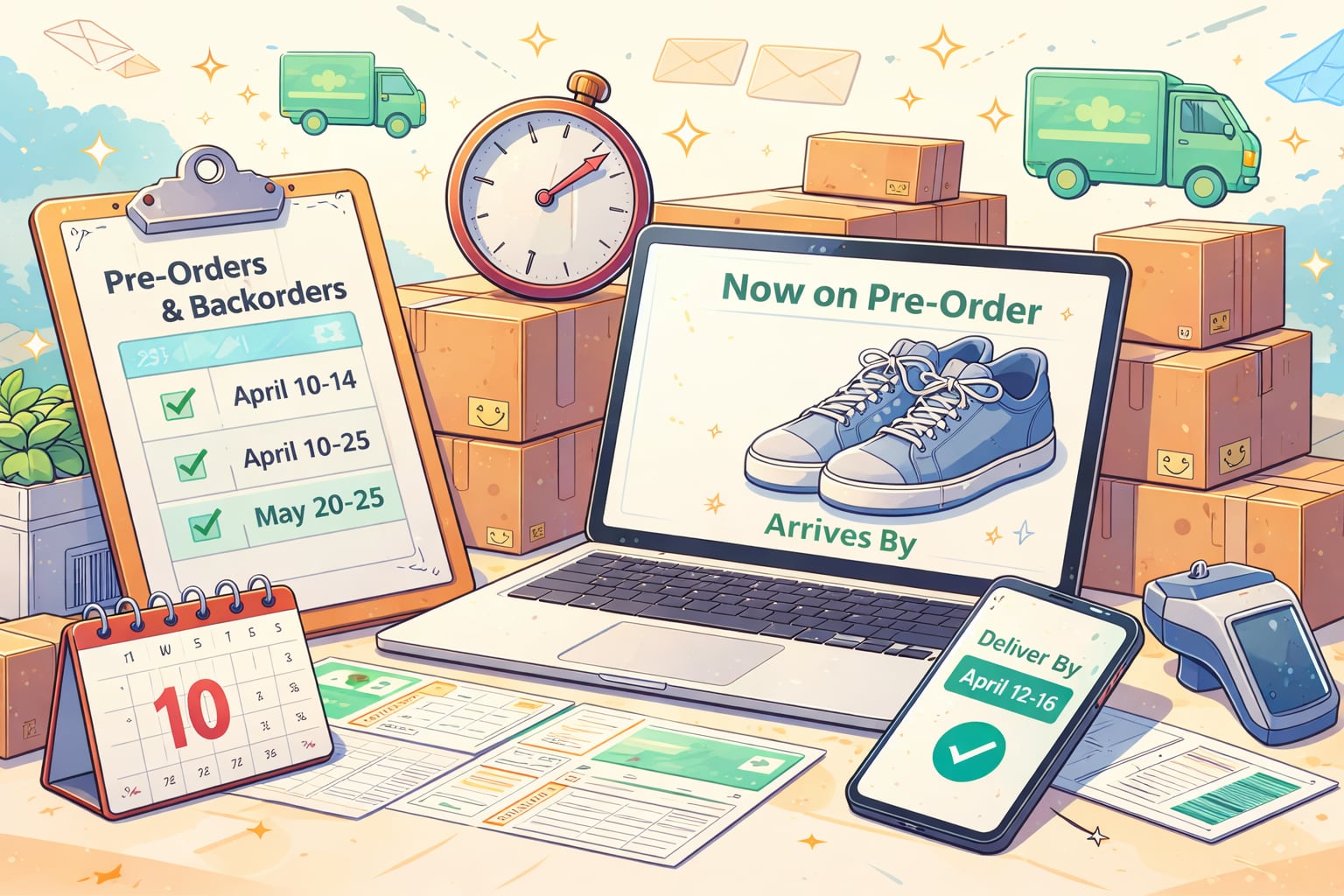
“Currently on backorder. Order now and get it by April 12–16.”
Now customers have an option. They don’t need to keep checking your site or shop around for alternatives.
And you continue generating revenue.
But this only works if you respect the timeline you show.
Missing those promised windows can damage your relationship with customers.
I once had a customer place an order knowing it would take 6–8 weeks. After six weeks, he called asking why it hadn’t shipped. Due to unexpected delays, we were going to miss the original window — and it would be another three weeks.
He was upset. He told me he wouldn’t have placed the order if he had known it would take that long.
He ultimately waited, but I knew we had lost him as a repeat customer.
This is why accurate estimates — and tracking how often you meet them — matter so much.
Stores that treat delivery timing as infrastructure — not just messaging — scale more reliably. We explored this in Scale Delivery Estimates.
Stockouts are inevitable. Broken promises don’t have to be.
Conclusion
Part of running a successful Shopify business is dealing with products going out of stock.
Backorders and pre-orders aren’t just ways to manage unavailable inventory — they’re opportunities to capture demand that would otherwise disappear.
But they only work when expectations are realistic and timelines are respected.
Accurate delivery dates allow customers to make informed decisions. They allow stores to maintain cash flow during stockouts. And over time, they build a reputation for reliability — even when products aren’t immediately available.
Speed might win urgency.
Accuracy wins loyalty.
If you want delivery timelines that stay aligned with real inventory and real performance as your store grows, tools built around operational discipline — not guesswork — make that possible.
You can see how ArrivesBy helps manage pre-order and backorder estimated delivery dates on Shopify.